
About us
Brazil at a Glance
Publications

AI gains ground as investment information source in Brazil
Published July 22, 2026
To share
X-ray of the Brazilian Investor survey shows 9% of investors already use AI assistants, with adoption highest among younger, wealthier and more diversified investors

Artificial intelligence assistants are beginning to reshape how Brazilians research financial products. Nine percent of investors already use AI as a source of investment information, placing the technology ahead of Facebook, email, TikTok, radio and other social networks.
The figure appears in the ninth edition of the X-ray of the Brazilian Investor, an annual survey conducted by Anbima (Brazilian Financial and Capital Markets Association) in partnership with research institute Datafolha. This was the first edition to measure the use of AI assistants in the investment journey.
AI outpaces several established channels
YouTube remains the leading source of investment information among Brazilian investors, cited by 35%, followed by Instagram, at 27%. Television ranks third, at 21%, although its share has fallen sharply from 34% in 2021.
Search engines such as Google, another category introduced in the latest survey, were mentioned by 20% of investors. Portals and websites and WhatsApp were each cited by 15%, while magazines and newspapers reached 14% and podcasts 13%.
Read more: X-ray of the Brazilian investor
AI assistants, at 9%, still trail the largest digital platforms but have already moved ahead of several longer-established channels.
The findings reinforce the growing importance of digital sources in the investment information journey. Among investors, 97% have internet access, and 77% say they are always connected. Among non-investors, those shares fall to 90% and 62%, respectively.
Younger investors lead AI adoption
The typical investor who uses AI is younger, male and higher-income. Men account for 67% of AI users, while women represent 33%. Generation Z makes up 49% of the group, followed by Millennials at 36%, Generation X at 12% and Boomers at 3%.
When adoption is measured within each demographic group, 17% of Generation Z investors use AI assistants to obtain information about financial products. The rate falls to 11% among Millennials, 4% among Generation X and 2% among Boomers.
The gender gap is narrower but still significant: 11% of male investors use AI, compared with 7% of women.
Income also plays a role. Brazil’s socioeconomic classification groups higher-income households in classes A and B, middle-income households in class C, and lower-income households in classes D and E.
Class AB represents 58% of investors who use AI, while class C accounts for 36% and class DE for 6%. Within each income group, AI adoption reaches 13% among class AB investors, 7% in class C and 4% in class DE.
AI users hold more diversified portfolios
Investors who turn to AI for financial information tend to have more diversified portfolios. Of this group, 77% invest in more than one financial product, while 23% hold only savings accounts.
Looking at the data from the opposite perspective leads to a similar conclusion: AI use is more common among investors with diversified portfolios. Among investors who hold more than one financial product, 14% use AI tools, versus only 4% of those whose investments are limited to savings accounts.
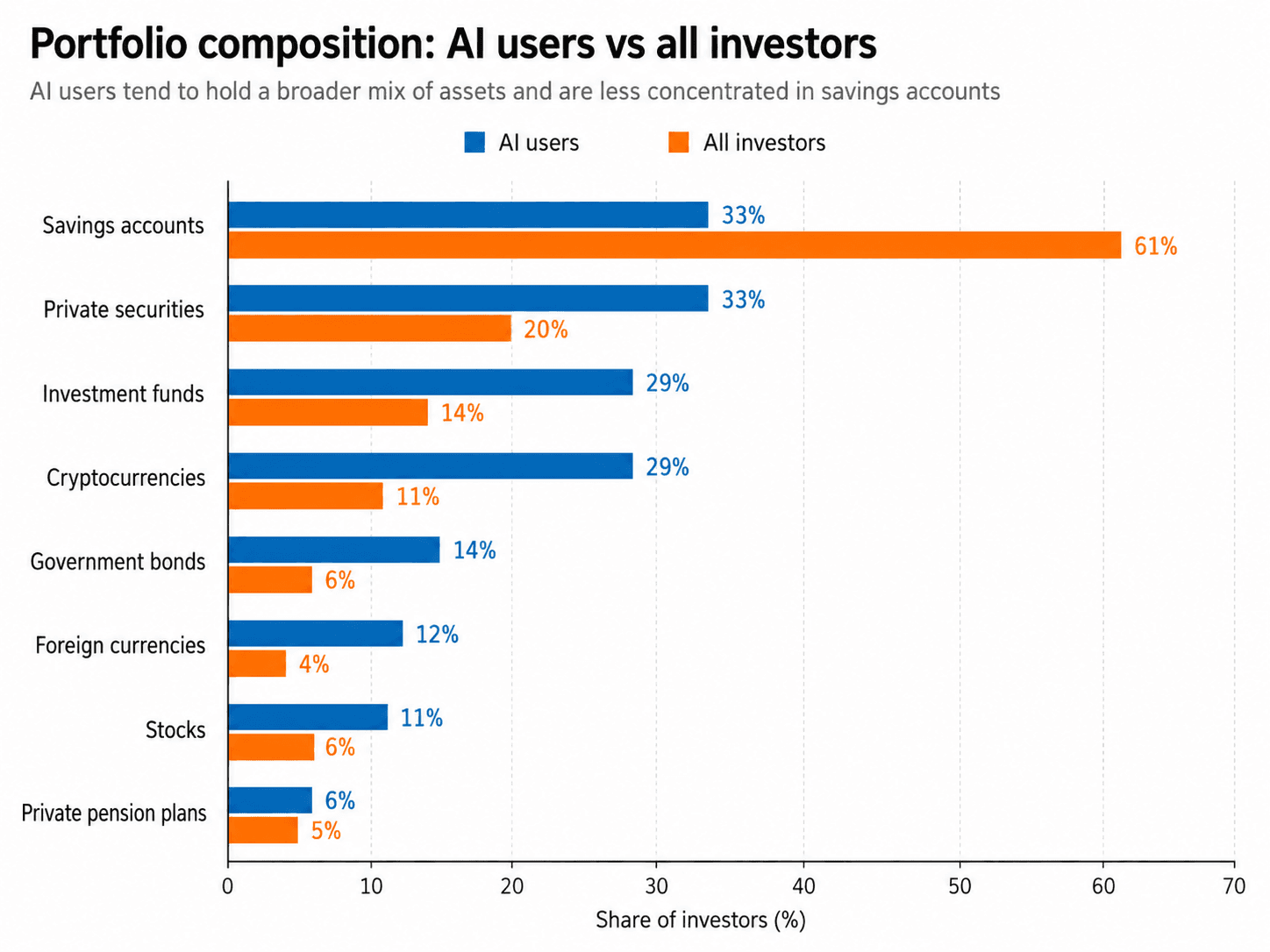
The composition of their portfolios also differs markedly from that of investors overall. Savings accounts are held by 33% of AI users, compared with 61% of all investors. By contrast, AI users are more likely to hold private securities, at 33% versus 20%; investment funds, at 29% versus 14%; and cryptocurrencies, at 29% versus 11%.
The same pattern extends to other assets. Government bonds are held by 14% of AI users, compared with 6% of investors overall, while foreign currencies appear in 12% of their portfolios, versus 4% among all investors. Stocks are held by 11%, compared with 6%, and private pension plans by 6%, broadly in line with the 5% seen among investors overall.
AI users show stronger intention to keep investing
Investors who use AI also appear more engaged with the market. Some 88% say they intend to invest in 2026, while 12% do not plan to do so.
Among all respondents who intend to invest in 2026, 10% use AI assistants for financial information. The rate is only 4% among those who do not intend to invest.
AI users also rely heavily on other digital channels. YouTube is cited by 51% of them, search engines by 41%, Instagram by 38%, and portals and websites by 35%. Television is used by only 9%.
Investment knowledge reaches a five-year high
The rise of AI comes as Brazilians become more familiar with financial products. The share of the population able to name at least one investment without being shown a list reached 43% in 2025, the highest level in the survey’s historical series and well above the 28% reported in 2021.
Financial education, however, remains limited. Only 21% of the population has attended a class, course, training session or lecture on the subject. The proportion rises to 33% among investors and 47% among people with diversified portfolios.
The survey was based on 5,832 in-person interviews conducted across Brazil from November 4 to 21, 2025. It covers people aged 16 and over from all socioeconomic groups and has a margin of error of one percentage point, with a 95% confidence level.
AI gains ground as investment information source in Brazil
Published July 22, 2026
To share
X-ray of the Brazilian Investor survey shows 9% of investors already use AI assistants, with adoption highest among younger, wealthier and more diversified investors
Artificial intelligence assistants are beginning to reshape how Brazilians research financial products. Nine percent of investors already use AI as a source of investment information, placing the technology ahead of Facebook, email, TikTok, radio and other social networks.
The figure appears in the ninth edition of the X-ray of the Brazilian Investor, an annual survey conducted by Anbima (Brazilian Financial and Capital Markets Association) in partnership with research institute Datafolha. This was the first edition to measure the use of AI assistants in the investment journey.
AI outpaces several established channels
YouTube remains the leading source of investment information among Brazilian investors, cited by 35%, followed by Instagram, at 27%. Television ranks third, at 21%, although its share has fallen sharply from 34% in 2021.
Search engines such as Google, another category introduced in the latest survey, were mentioned by 20% of investors. Portals and websites and WhatsApp were each cited by 15%, while magazines and newspapers reached 14% and podcasts 13%.
Read more: X-ray of the Brazilian investor
AI assistants, at 9%, still trail the largest digital platforms but have already moved ahead of several longer-established channels.
The findings reinforce the growing importance of digital sources in the investment information journey. Among investors, 97% have internet access, and 77% say they are always connected. Among non-investors, those shares fall to 90% and 62%, respectively.
Younger investors lead AI adoption
The typical investor who uses AI is younger, male and higher-income. Men account for 67% of AI users, while women represent 33%. Generation Z makes up 49% of the group, followed by Millennials at 36%, Generation X at 12% and Boomers at 3%.
When adoption is measured within each demographic group, 17% of Generation Z investors use AI assistants to obtain information about financial products. The rate falls to 11% among Millennials, 4% among Generation X and 2% among Boomers.
The gender gap is narrower but still significant: 11% of male investors use AI, compared with 7% of women.
Income also plays a role. Brazil’s socioeconomic classification groups higher-income households in classes A and B, middle-income households in class C, and lower-income households in classes D and E.
Class AB represents 58% of investors who use AI, while class C accounts for 36% and class DE for 6%. Within each income group, AI adoption reaches 13% among class AB investors, 7% in class C and 4% in class DE.
AI users hold more diversified portfolios
Investors who turn to AI for financial information tend to have more diversified portfolios. Of this group, 77% invest in more than one financial product, while 23% hold only savings accounts.
Looking at the data from the opposite perspective leads to a similar conclusion: AI use is more common among investors with diversified portfolios. Among investors who hold more than one financial product, 14% use AI tools, versus only 4% of those whose investments are limited to savings accounts.
The composition of their portfolios also differs markedly from that of investors overall. Savings accounts are held by 33% of AI users, compared with 61% of all investors. By contrast, AI users are more likely to hold private securities, at 33% versus 20%; investment funds, at 29% versus 14%; and cryptocurrencies, at 29% versus 11%.
The same pattern extends to other assets. Government bonds are held by 14% of AI users, compared with 6% of investors overall, while foreign currencies appear in 12% of their portfolios, versus 4% among all investors. Stocks are held by 11%, compared with 6%, and private pension plans by 6%, broadly in line with the 5% seen among investors overall.
AI users show stronger intention to keep investing
Investors who use AI also appear more engaged with the market. Some 88% say they intend to invest in 2026, while 12% do not plan to do so.
Among all respondents who intend to invest in 2026, 10% use AI assistants for financial information. The rate is only 4% among those who do not intend to invest.
AI users also rely heavily on other digital channels. YouTube is cited by 51% of them, search engines by 41%, Instagram by 38%, and portals and websites by 35%. Television is used by only 9%.
Investment knowledge reaches a five-year high
The rise of AI comes as Brazilians become more familiar with financial products. The share of the population able to name at least one investment without being shown a list reached 43% in 2025, the highest level in the survey’s historical series and well above the 28% reported in 2021.
Financial education, however, remains limited. Only 21% of the population has attended a class, course, training session or lecture on the subject. The proportion rises to 33% among investors and 47% among people with diversified portfolios.
The survey was based on 5,832 in-person interviews conducted across Brazil from November 4 to 21, 2025. It covers people aged 16 and over from all socioeconomic groups and has a margin of error of one percentage point, with a 95% confidence level.
AI gains ground as investment information source in Brazil
Published July 22, 2026
To share
X-ray of the Brazilian Investor survey shows 9% of investors already use AI assistants, with adoption highest among younger, wealthier and more diversified investors
Artificial intelligence assistants are beginning to reshape how Brazilians research financial products. Nine percent of investors already use AI as a source of investment information, placing the technology ahead of Facebook, email, TikTok, radio and other social networks.
The figure appears in the ninth edition of the X-ray of the Brazilian Investor, an annual survey conducted by Anbima (Brazilian Financial and Capital Markets Association) in partnership with research institute Datafolha. This was the first edition to measure the use of AI assistants in the investment journey.
AI outpaces several established channels
YouTube remains the leading source of investment information among Brazilian investors, cited by 35%, followed by Instagram, at 27%. Television ranks third, at 21%, although its share has fallen sharply from 34% in 2021.
Search engines such as Google, another category introduced in the latest survey, were mentioned by 20% of investors. Portals and websites and WhatsApp were each cited by 15%, while magazines and newspapers reached 14% and podcasts 13%.
Read more: X-ray of the Brazilian investor
AI assistants, at 9%, still trail the largest digital platforms but have already moved ahead of several longer-established channels.
The findings reinforce the growing importance of digital sources in the investment information journey. Among investors, 97% have internet access, and 77% say they are always connected. Among non-investors, those shares fall to 90% and 62%, respectively.
Younger investors lead AI adoption
The typical investor who uses AI is younger, male and higher-income. Men account for 67% of AI users, while women represent 33%. Generation Z makes up 49% of the group, followed by Millennials at 36%, Generation X at 12% and Boomers at 3%.
When adoption is measured within each demographic group, 17% of Generation Z investors use AI assistants to obtain information about financial products. The rate falls to 11% among Millennials, 4% among Generation X and 2% among Boomers.
The gender gap is narrower but still significant: 11% of male investors use AI, compared with 7% of women.
Income also plays a role. Brazil’s socioeconomic classification groups higher-income households in classes A and B, middle-income households in class C, and lower-income households in classes D and E.
Class AB represents 58% of investors who use AI, while class C accounts for 36% and class DE for 6%. Within each income group, AI adoption reaches 13% among class AB investors, 7% in class C and 4% in class DE.
AI users hold more diversified portfolios
Investors who turn to AI for financial information tend to have more diversified portfolios. Of this group, 77% invest in more than one financial product, while 23% hold only savings accounts.
Looking at the data from the opposite perspective leads to a similar conclusion: AI use is more common among investors with diversified portfolios. Among investors who hold more than one financial product, 14% use AI tools, versus only 4% of those whose investments are limited to savings accounts.
The composition of their portfolios also differs markedly from that of investors overall. Savings accounts are held by 33% of AI users, compared with 61% of all investors. By contrast, AI users are more likely to hold private securities, at 33% versus 20%; investment funds, at 29% versus 14%; and cryptocurrencies, at 29% versus 11%.
The same pattern extends to other assets. Government bonds are held by 14% of AI users, compared with 6% of investors overall, while foreign currencies appear in 12% of their portfolios, versus 4% among all investors. Stocks are held by 11%, compared with 6%, and private pension plans by 6%, broadly in line with the 5% seen among investors overall.
AI users show stronger intention to keep investing
Investors who use AI also appear more engaged with the market. Some 88% say they intend to invest in 2026, while 12% do not plan to do so.
Among all respondents who intend to invest in 2026, 10% use AI assistants for financial information. The rate is only 4% among those who do not intend to invest.
AI users also rely heavily on other digital channels. YouTube is cited by 51% of them, search engines by 41%, Instagram by 38%, and portals and websites by 35%. Television is used by only 9%.
Investment knowledge reaches a five-year high
The rise of AI comes as Brazilians become more familiar with financial products. The share of the population able to name at least one investment without being shown a list reached 43% in 2025, the highest level in the survey’s historical series and well above the 28% reported in 2021.
Financial education, however, remains limited. Only 21% of the population has attended a class, course, training session or lecture on the subject. The proportion rises to 33% among investors and 47% among people with diversified portfolios.
The survey was based on 5,832 in-person interviews conducted across Brazil from November 4 to 21, 2025. It covers people aged 16 and over from all socioeconomic groups and has a margin of error of one percentage point, with a 95% confidence level.
Get exclusive updates by email
Receive news, tips, events, and much more directly to your inbox.
Get exclusive updates by email
Receive news, tips, events, and much more directly to your inbox.