
About us
Brazil at a Glance
Publications

Anbima brings Brazil’s capital markets perspective to Davos
Published January 22, 2026
To share
First participation alongside the World Climate Foundation positions the association as a voice in global debates on sustainable finance
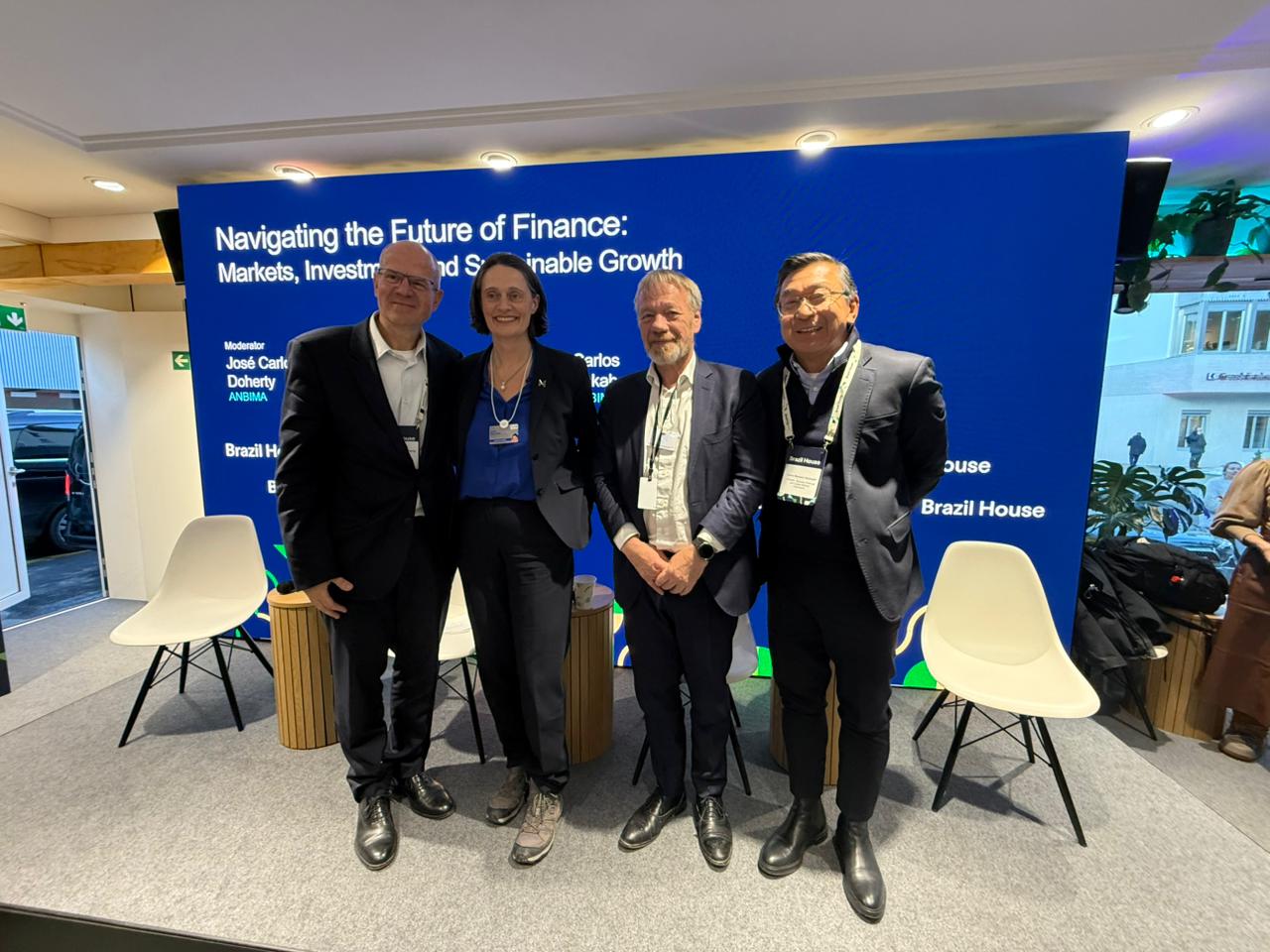
José Carlos Doherty (Anbima), Amy Barnes (Marsh), Jens Nielsen (World Climate Foundation), and Carlos Takahashi (Anbima)
This week, Anbima joined the discussions at the World Economic Forum in Davos, Switzerland, contributing the perspective of Brazil’s capital markets to a global forum that shapes economic, political, and sustainability agendas. In partnership with the World Climate Foundation, the association engaged with global leaders to highlight how emerging markets can play a decisive role in advancing sustainable finance and aligning capital flows with long-term development goals.
In a year shaped by intense discussions on innovation and geopolitics, topics such as artificial intelligence, quantum computing, asset tokenization, stablecoins, and other technological advances dominated the Forum’s agenda. Attention was also focused on the outlook for the global economy amid an evolving international political landscape, strongly influenced by the return of U.S. President Donald Trump to the center of global debate.
This backdrop of rapid technological change combined with political uncertainty pushed leadership and governance challenges to the forefront. These issues directly affect companies, investors, and regulators, setting the stage for more pragmatic conversations about decision-making and execution in highly volatile environments.
CEO roundtable
Against this backdrop, Anbima expanded dialogue around key capital markets priorities throughout the event and strengthened connections with global leaders. One highlight was Anbima’s participation in a CEO roundtable on the challenges of leading companies and organizations in a context of heightened uncertainty.
The meeting brought together around 20 CEOs from different countries and sectors, including Anbima’s CEO, José Carlos Doherty, who was the only participant representing an emerging market.
“The discussion allowed CEOs from very different regions and industries to share their perspectives on leading in a world marked by major geopolitical, social, and legal instability. We also used this forum to show how the experience of leading in a country like Brazil, which is used to navigating uncertainty, can serve as a reference for leaders around the world,” Doherty said.
Despite differences in context and markets, CEOs face common challenges, such as balancing pressure from the top, including shareholders and boards, while managing internal expectations in an environment of uncertainty and rapid change. “And in the middle of all this, CEOs still need to identify good opportunities for their companies and organizations. It is a very complex moment,” he added.
Sustainable development
In partnership with the World Climate Foundation, Anbima also hosted a panel during this year’s World Economic Forum focused on sustainable development. Held at the Brazil House, a space dedicated to themes of interest to Brazil in Davos, the panel “Navigating the Future of Finance: Markets, Investment, and Sustainable Growth” explored how companies and financial institutions can channel resilient and innovative investment in a fast-changing environment.
Anbima was represented on the panel by Doherty, who served as moderator, and by Carlos Takahashi, a director at Anbima and head of the Anbima Sustainability Network, as a speaker. The discussion examined the regulatory challenges that must be addressed to ensure the ESG agenda earns long-term investor trust. It also looked at the main trends shaping capital flows, as well as the opportunities and challenges involved in embedding sustainable finance and ESG factors into decision-making.
“We showed how global trends in capital flows, including the energy transition, are influencing markets in Brazil and Latin America. We also discussed how this environment connects with regulatory and self-regulatory priorities in Brazil and Anbima’s role in aligning our market with global best practices in ESG and sustainable investment,” Takahashi said.
Building connections and sharing experience
In another initiative held during the World Economic Forum, once again in partnership with the World Climate Foundation, Anbima hosted a networking dinner with executives from major global companies and financial institutions. The aim was to create a space for sharing experiences, perspectives, and trends to help shape priorities for 2026. In addition to strengthening relationships and building connections with international leaders, the event provided an opportunity to introduce Anbima, its activities, and its commitments to a select audience.
“Our goal was to deepen ties and build partnerships around initiatives that accelerate results. This is fully aligned with our role of building bridges that unlock value for the real economy and for investors, while raising the standard of market practices,” said Doherty, highlighting the importance of Anbima’s partnership with the World Climate Foundation in sustainable finance events.
“Anbima’s agenda is focused on developing and strengthening the market. In recent years, it has gained a new dimension: sustainability. Sustainable finance has become urgent not because it is fashionable, but because there is a clear understanding that the world needs a low-carbon economy,” he concluded.
Anbima brings Brazil’s capital markets perspective to Davos
Published January 22, 2026
To share
First participation alongside the World Climate Foundation positions the association as a voice in global debates on sustainable finance
José Carlos Doherty (Anbima), Amy Barnes (Marsh), Jens Nielsen (World Climate Foundation), and Carlos Takahashi (Anbima)
This week, Anbima joined the discussions at the World Economic Forum in Davos, Switzerland, contributing the perspective of Brazil’s capital markets to a global forum that shapes economic, political, and sustainability agendas. In partnership with the World Climate Foundation, the association engaged with global leaders to highlight how emerging markets can play a decisive role in advancing sustainable finance and aligning capital flows with long-term development goals.
In a year shaped by intense discussions on innovation and geopolitics, topics such as artificial intelligence, quantum computing, asset tokenization, stablecoins, and other technological advances dominated the Forum’s agenda. Attention was also focused on the outlook for the global economy amid an evolving international political landscape, strongly influenced by the return of U.S. President Donald Trump to the center of global debate.
This backdrop of rapid technological change combined with political uncertainty pushed leadership and governance challenges to the forefront. These issues directly affect companies, investors, and regulators, setting the stage for more pragmatic conversations about decision-making and execution in highly volatile environments.
CEO roundtable
Against this backdrop, Anbima expanded dialogue around key capital markets priorities throughout the event and strengthened connections with global leaders. One highlight was Anbima’s participation in a CEO roundtable on the challenges of leading companies and organizations in a context of heightened uncertainty.
The meeting brought together around 20 CEOs from different countries and sectors, including Anbima’s CEO, José Carlos Doherty, who was the only participant representing an emerging market.
“The discussion allowed CEOs from very different regions and industries to share their perspectives on leading in a world marked by major geopolitical, social, and legal instability. We also used this forum to show how the experience of leading in a country like Brazil, which is used to navigating uncertainty, can serve as a reference for leaders around the world,” Doherty said.
Despite differences in context and markets, CEOs face common challenges, such as balancing pressure from the top, including shareholders and boards, while managing internal expectations in an environment of uncertainty and rapid change. “And in the middle of all this, CEOs still need to identify good opportunities for their companies and organizations. It is a very complex moment,” he added.
Sustainable development
In partnership with the World Climate Foundation, Anbima also hosted a panel during this year’s World Economic Forum focused on sustainable development. Held at the Brazil House, a space dedicated to themes of interest to Brazil in Davos, the panel “Navigating the Future of Finance: Markets, Investment, and Sustainable Growth” explored how companies and financial institutions can channel resilient and innovative investment in a fast-changing environment.
Anbima was represented on the panel by Doherty, who served as moderator, and by Carlos Takahashi, a director at Anbima and head of the Anbima Sustainability Network, as a speaker. The discussion examined the regulatory challenges that must be addressed to ensure the ESG agenda earns long-term investor trust. It also looked at the main trends shaping capital flows, as well as the opportunities and challenges involved in embedding sustainable finance and ESG factors into decision-making.
“We showed how global trends in capital flows, including the energy transition, are influencing markets in Brazil and Latin America. We also discussed how this environment connects with regulatory and self-regulatory priorities in Brazil and Anbima’s role in aligning our market with global best practices in ESG and sustainable investment,” Takahashi said.
Building connections and sharing experience
In another initiative held during the World Economic Forum, once again in partnership with the World Climate Foundation, Anbima hosted a networking dinner with executives from major global companies and financial institutions. The aim was to create a space for sharing experiences, perspectives, and trends to help shape priorities for 2026. In addition to strengthening relationships and building connections with international leaders, the event provided an opportunity to introduce Anbima, its activities, and its commitments to a select audience.
“Our goal was to deepen ties and build partnerships around initiatives that accelerate results. This is fully aligned with our role of building bridges that unlock value for the real economy and for investors, while raising the standard of market practices,” said Doherty, highlighting the importance of Anbima’s partnership with the World Climate Foundation in sustainable finance events.
“Anbima’s agenda is focused on developing and strengthening the market. In recent years, it has gained a new dimension: sustainability. Sustainable finance has become urgent not because it is fashionable, but because there is a clear understanding that the world needs a low-carbon economy,” he concluded.
Anbima brings Brazil’s capital markets perspective to Davos
Published January 22, 2026
To share
First participation alongside the World Climate Foundation positions the association as a voice in global debates on sustainable finance
José Carlos Doherty (Anbima), Amy Barnes (Marsh), Jens Nielsen (World Climate Foundation), and Carlos Takahashi (Anbima)
This week, Anbima joined the discussions at the World Economic Forum in Davos, Switzerland, contributing the perspective of Brazil’s capital markets to a global forum that shapes economic, political, and sustainability agendas. In partnership with the World Climate Foundation, the association engaged with global leaders to highlight how emerging markets can play a decisive role in advancing sustainable finance and aligning capital flows with long-term development goals.
In a year shaped by intense discussions on innovation and geopolitics, topics such as artificial intelligence, quantum computing, asset tokenization, stablecoins, and other technological advances dominated the Forum’s agenda. Attention was also focused on the outlook for the global economy amid an evolving international political landscape, strongly influenced by the return of U.S. President Donald Trump to the center of global debate.
This backdrop of rapid technological change combined with political uncertainty pushed leadership and governance challenges to the forefront. These issues directly affect companies, investors, and regulators, setting the stage for more pragmatic conversations about decision-making and execution in highly volatile environments.
CEO roundtable
Against this backdrop, Anbima expanded dialogue around key capital markets priorities throughout the event and strengthened connections with global leaders. One highlight was Anbima’s participation in a CEO roundtable on the challenges of leading companies and organizations in a context of heightened uncertainty.
The meeting brought together around 20 CEOs from different countries and sectors, including Anbima’s CEO, José Carlos Doherty, who was the only participant representing an emerging market.
“The discussion allowed CEOs from very different regions and industries to share their perspectives on leading in a world marked by major geopolitical, social, and legal instability. We also used this forum to show how the experience of leading in a country like Brazil, which is used to navigating uncertainty, can serve as a reference for leaders around the world,” Doherty said.
Despite differences in context and markets, CEOs face common challenges, such as balancing pressure from the top, including shareholders and boards, while managing internal expectations in an environment of uncertainty and rapid change. “And in the middle of all this, CEOs still need to identify good opportunities for their companies and organizations. It is a very complex moment,” he added.
Sustainable development
In partnership with the World Climate Foundation, Anbima also hosted a panel during this year’s World Economic Forum focused on sustainable development. Held at the Brazil House, a space dedicated to themes of interest to Brazil in Davos, the panel “Navigating the Future of Finance: Markets, Investment, and Sustainable Growth” explored how companies and financial institutions can channel resilient and innovative investment in a fast-changing environment.
Anbima was represented on the panel by Doherty, who served as moderator, and by Carlos Takahashi, a director at Anbima and head of the Anbima Sustainability Network, as a speaker. The discussion examined the regulatory challenges that must be addressed to ensure the ESG agenda earns long-term investor trust. It also looked at the main trends shaping capital flows, as well as the opportunities and challenges involved in embedding sustainable finance and ESG factors into decision-making.
“We showed how global trends in capital flows, including the energy transition, are influencing markets in Brazil and Latin America. We also discussed how this environment connects with regulatory and self-regulatory priorities in Brazil and Anbima’s role in aligning our market with global best practices in ESG and sustainable investment,” Takahashi said.
Building connections and sharing experience
In another initiative held during the World Economic Forum, once again in partnership with the World Climate Foundation, Anbima hosted a networking dinner with executives from major global companies and financial institutions. The aim was to create a space for sharing experiences, perspectives, and trends to help shape priorities for 2026. In addition to strengthening relationships and building connections with international leaders, the event provided an opportunity to introduce Anbima, its activities, and its commitments to a select audience.
“Our goal was to deepen ties and build partnerships around initiatives that accelerate results. This is fully aligned with our role of building bridges that unlock value for the real economy and for investors, while raising the standard of market practices,” said Doherty, highlighting the importance of Anbima’s partnership with the World Climate Foundation in sustainable finance events.
“Anbima’s agenda is focused on developing and strengthening the market. In recent years, it has gained a new dimension: sustainability. Sustainable finance has become urgent not because it is fashionable, but because there is a clear understanding that the world needs a low-carbon economy,” he concluded.
Get exclusive updates by email
Receive news, tips, events, and much more directly to your inbox.
Get exclusive updates by email
Receive news, tips, events, and much more directly to your inbox.