
About us
Brazil at a Glance
Publications

Anbima steps up market supervision
Published September 23, 2026
To share
Structured-fund monitoring, visits to securitization companies and growing use of artificial intelligence stand out in the first half

Anbima (Brazilian Financial and Capital Markets Association) stepped up its guidance and market monitoring efforts in the first half of 2026, working to help firms understand the rules while identifying and investigating potential breaches of self-regulation requirements.
The work resulted in firmer action in cases requiring investigation and closer monitoring of expanding areas, including structured funds and financial institutions subject to the Code for Public Offerings, such as securitization companies.
Between January and June, Anbima adjudicated 10 cases, entered into seven settlement agreements and issued nine recommendation letters.
“The first-half results reflect work that combines monitoring, guidance, investigation and accountability. This approach allows practices to be corrected and, in cases involving more serious indications of misconduct, procedures and proceedings to be opened, which may ultimately lead to judgments by the self-regulation councils,” said Guilherme Benaderet, Anbima’s head of market supervision.
Supervision in numbers
All 10 cases adjudicated were related to Anbima’s self-regulation code for third-party asset administration and management. In three proceedings, the firms were removed from the code, resulting in the loss of the right to use the Anbima seal.
These cases are reviewed at different levels. The self-regulation councils are the highest decision-making bodies. They decide whether to accept settlement proposals submitted by firms in cases of potential non-compliance and determine the penalties imposed in adjudicated cases, following the due process for submissions and interactions established in Anbima’s Proceedings Code.
The monitoring committees, in turn, decide whether proceedings should be opened, whether recommendation letters should be issued and provide guidance for the work carried out by the supervision team.
“When a case reaches these bodies, it has already gone through monitoring, identification of potential issues and investigation by the technical team,” Benaderet said. “Our role is to gather robust evidence to support sound, independent decisions. Both the committee and the council have autonomy in their decisions and may agree or disagree with the supervision team’s assessment.”
Preventive measures also illustrate the work that takes place before cases reach these bodies. Preventive letters rose from 88 in the first half of 2025 to 744 this year, driven by the use of technology that makes it easier to monitor information submitted by firms and analyze documents such as policies, methodologies and databases.
In cases where guidance required more structured measures, action plans increased from seven to 40. The tool allows Anbima to define the adjustments required and monitor their implementation by firms.
Monitoring also resulted in 469 warning letters, up from 83 in the same period of 2025. Among the issues that required the most attention were delays in quarterly reports from private equity investment funds (FIPs) and problems involving fund registration data.
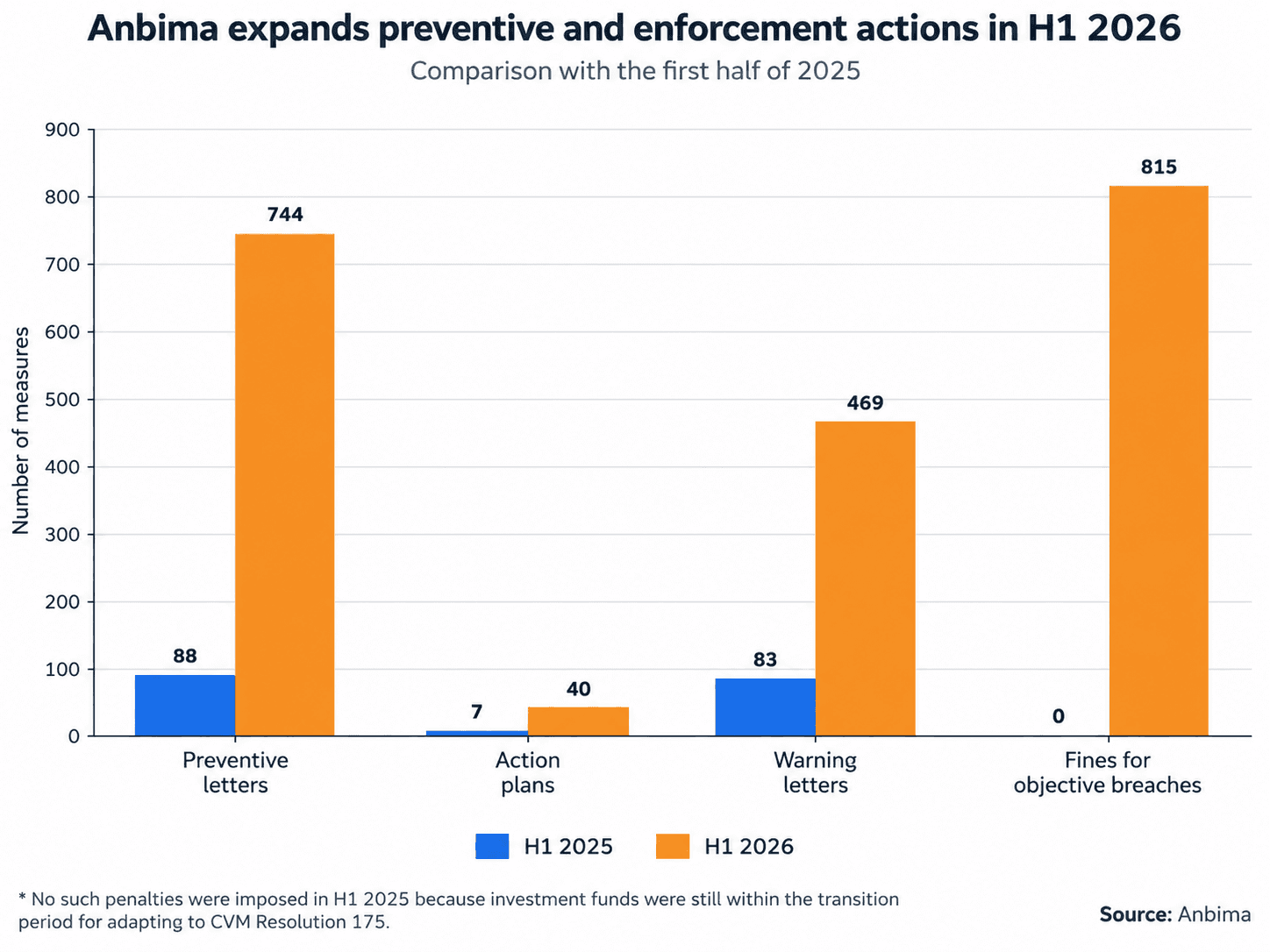
We also imposed 815 fines for objective breaches, involving delays or inconsistencies in investment fund registrations and amendments, late registration of public offerings, and late or missing submissions to Anbima databases. No such penalties were imposed in the first half of 2025 because investment funds were still within the transition period for adapting to Resolution 175 issued by the Securities and Exchange Commission of Brazil (CVM).
Anbima’s self-regulation codes also gained 59 new signatories in the first half of the year. The code for third-party asset administration and management accounted for the largest number, with 35, followed by the Code for Public Offerings, with 18. Growth in the latter was driven in part by securitization companies joining the framework.
Structured funds under closer scrutiny
Structured funds were among the main areas of focus, particularly credit rights investment funds (FIDCs), private equity investment funds (FIPs) and real estate investment funds (FIIs).
During the first half, alongside investigative work involving asset acquisition and monitoring, portfolio compliance, provisions for doubtful receivables and asset pricing, we intensified the assessment of potential breaches involving issues such as conflicts of interest and transactions lacking a justifiable economic purpose.
We also stepped up scrutiny of missing or inconsistent filings, allowing problems to be identified earlier and financial institutions to be required to bring their information up to date.
In one initiative, 21 fund administrators were required to regularize quarterly reports for 121 FIDCs that were overdue. The work has already led to some of the outstanding reports being brought up to date.
This information also supports analysis of areas such as verification of underlying receivables, monitoring of credit rights, loss provisioning, and policies for acquiring and monitoring private credit assets.
Closer engagement
Supervision efforts were complemented by visits and meetings with firms. In the first half, we conducted 32 visits to firms subject to the code for third-party asset administration and management. The agenda also included visits to 26 securitization companies and meetings with three new public offering coordinators.
These interactions give Anbima a closer look at the structures, processes and controls adopted by financial institutions, while providing an opportunity to answer questions and identify areas for improvement. The aim is to gradually expand this work to reach all securitization companies and new participants in the market segments we monitor.
Issues identified during these meetings also shaped an open meeting on best practices for securitization companies, held with the participation of the CVM. More than 280 people attended the event virtually.
In the second half of the year, Anbima will hold an open meeting with fund managers to share some of the findings from Anbima visits and other supervision activities.
Anbima’s engagement with the market also extended to fund registration. The Association launched Conexão Cadastros, an initiative that complements training on fund registration and promotes targeted discussions with firms about the most common errors identified by the technical team. Six meetings were held in the first half.
“In addition to producing guidance for the market as a whole, we want to understand the specific difficulties faced by financial institutions and address them directly. ‘Conexão Cadastros’ turns problems identified by the team into targeted conversations that help correct information and prevent new inconsistencies,” said Audrey Almeida, Anbima’s manager of Preventive Actions and Registrations Unit.
Preventive work also included notices and guidance on issues such as asset manager compensation summaries, registration of transactions in the Trade Registration System, verification of underlying assets and preparation of the mandatory policies required under Anbima’s codes.
These initiatives help financial institutions understand the rules and allow weaknesses to be addressed before they develop into more significant problems.
Public offering reviews more than double
Anbima’s cooperation agreement with the CVM for the prior review of public offerings continued to expand. Between January and June, the Association received 41 submissions, more than double the 19 applications in the same period of 2025. The increase was approximately 116%, with FIIs accounting for a significant share.
Under the agreement, offerings reviewed by Anbima that receive an unqualified opinion can be registered automatically by the CVM. The model makes the process more efficient while allowing the regulator to draw on the work carried out by the association.
The range of products eligible for the process was also expanded at the end of the first half. Commercial notes, Agribusiness Receivables Certificates (CRAs), Receivables Certificates (CRs) and other securitization instruments were added to the list of eligible offerings.
The change broadens the scope of the agreement and reflects the increasing diversity of instruments used by the market.
Technology expands monitoring capabilities
The use of analytical models, machine-learning algorithms and artificial intelligence has increasingly enabled Anbima to identify patterns and signs of potential irregularities in a fraction of the time previously required for manual reviews.
Activities and monitoring processes that once relied on sampling and periodic reviews can now process vast volumes of data, substantially expanding the scope of supervision.
Driven by the more intensive adoption of these technologies, the supervision team has seen significant gains in speed, accuracy and coverage when identifying irregularities and potential risks.
Technology also reduces the time spent on repetitive tasks, allowing technical teams to focus on cases requiring more in-depth analysis. This enables Anbima to allocate resources more effectively and respond more promptly as the market becomes increasingly complex. This has remained a consistent priority.
Greater transparency and faster processes
The first-half results are also helping shape the next steps for market supervision. Initiatives planned for the second half include a review of the Proceedings Code and the creation of a dedicated supervision section on the Anbima website.
The code review, which was submitted to public consultation, seeks to improve enforcement process. The proposed changes are designed to make the stages of investigations more transparent and allow for faster monitoring of capital market institutions.
The new digital environment, meanwhile, responds to a request from the market and will bring together information on the tools used in supervision, proceedings and self-regulation decisions, among other content, making this information easier for market participants to access.
Both initiatives build on the strengthening of supervision seen during the first half. By making the path from the identification of a potential irregularity through its investigation and the resulting action clearer, Anbima is increasing the transparency of its processes and strengthening its ability to respond to changes in the market.
Anbima steps up market supervision
Published September 23, 2026
To share
Structured-fund monitoring, visits to securitization companies and growing use of artificial intelligence stand out in the first half
Anbima (Brazilian Financial and Capital Markets Association) stepped up its guidance and market monitoring efforts in the first half of 2026, working to help firms understand the rules while identifying and investigating potential breaches of self-regulation requirements.
The work resulted in firmer action in cases requiring investigation and closer monitoring of expanding areas, including structured funds and financial institutions subject to the Code for Public Offerings, such as securitization companies.
Between January and June, Anbima adjudicated 10 cases, entered into seven settlement agreements and issued nine recommendation letters.
“The first-half results reflect work that combines monitoring, guidance, investigation and accountability. This approach allows practices to be corrected and, in cases involving more serious indications of misconduct, procedures and proceedings to be opened, which may ultimately lead to judgments by the self-regulation councils,” said Guilherme Benaderet, Anbima’s head of market supervision.
Supervision in numbers
All 10 cases adjudicated were related to Anbima’s self-regulation code for third-party asset administration and management. In three proceedings, the firms were removed from the code, resulting in the loss of the right to use the Anbima seal.
These cases are reviewed at different levels. The self-regulation councils are the highest decision-making bodies. They decide whether to accept settlement proposals submitted by firms in cases of potential non-compliance and determine the penalties imposed in adjudicated cases, following the due process for submissions and interactions established in Anbima’s Proceedings Code.
The monitoring committees, in turn, decide whether proceedings should be opened, whether recommendation letters should be issued and provide guidance for the work carried out by the supervision team.
“When a case reaches these bodies, it has already gone through monitoring, identification of potential issues and investigation by the technical team,” Benaderet said. “Our role is to gather robust evidence to support sound, independent decisions. Both the committee and the council have autonomy in their decisions and may agree or disagree with the supervision team’s assessment.”
Preventive measures also illustrate the work that takes place before cases reach these bodies. Preventive letters rose from 88 in the first half of 2025 to 744 this year, driven by the use of technology that makes it easier to monitor information submitted by firms and analyze documents such as policies, methodologies and databases.
In cases where guidance required more structured measures, action plans increased from seven to 40. The tool allows Anbima to define the adjustments required and monitor their implementation by firms.
Monitoring also resulted in 469 warning letters, up from 83 in the same period of 2025. Among the issues that required the most attention were delays in quarterly reports from private equity investment funds (FIPs) and problems involving fund registration data.
We also imposed 815 fines for objective breaches, involving delays or inconsistencies in investment fund registrations and amendments, late registration of public offerings, and late or missing submissions to Anbima databases. No such penalties were imposed in the first half of 2025 because investment funds were still within the transition period for adapting to Resolution 175 issued by the Securities and Exchange Commission of Brazil (CVM).
Anbima’s self-regulation codes also gained 59 new signatories in the first half of the year. The code for third-party asset administration and management accounted for the largest number, with 35, followed by the Code for Public Offerings, with 18. Growth in the latter was driven in part by securitization companies joining the framework.
Structured funds under closer scrutiny
Structured funds were among the main areas of focus, particularly credit rights investment funds (FIDCs), private equity investment funds (FIPs) and real estate investment funds (FIIs).
During the first half, alongside investigative work involving asset acquisition and monitoring, portfolio compliance, provisions for doubtful receivables and asset pricing, we intensified the assessment of potential breaches involving issues such as conflicts of interest and transactions lacking a justifiable economic purpose.
We also stepped up scrutiny of missing or inconsistent filings, allowing problems to be identified earlier and financial institutions to be required to bring their information up to date.
In one initiative, 21 fund administrators were required to regularize quarterly reports for 121 FIDCs that were overdue. The work has already led to some of the outstanding reports being brought up to date.
This information also supports analysis of areas such as verification of underlying receivables, monitoring of credit rights, loss provisioning, and policies for acquiring and monitoring private credit assets.
Closer engagement
Supervision efforts were complemented by visits and meetings with firms. In the first half, we conducted 32 visits to firms subject to the code for third-party asset administration and management. The agenda also included visits to 26 securitization companies and meetings with three new public offering coordinators.
These interactions give Anbima a closer look at the structures, processes and controls adopted by financial institutions, while providing an opportunity to answer questions and identify areas for improvement. The aim is to gradually expand this work to reach all securitization companies and new participants in the market segments we monitor.
Issues identified during these meetings also shaped an open meeting on best practices for securitization companies, held with the participation of the CVM. More than 280 people attended the event virtually.
In the second half of the year, Anbima will hold an open meeting with fund managers to share some of the findings from Anbima visits and other supervision activities.
Anbima’s engagement with the market also extended to fund registration. The Association launched Conexão Cadastros, an initiative that complements training on fund registration and promotes targeted discussions with firms about the most common errors identified by the technical team. Six meetings were held in the first half.
“In addition to producing guidance for the market as a whole, we want to understand the specific difficulties faced by financial institutions and address them directly. ‘Conexão Cadastros’ turns problems identified by the team into targeted conversations that help correct information and prevent new inconsistencies,” said Audrey Almeida, Anbima’s manager of Preventive Actions and Registrations Unit.
Preventive work also included notices and guidance on issues such as asset manager compensation summaries, registration of transactions in the Trade Registration System, verification of underlying assets and preparation of the mandatory policies required under Anbima’s codes.
These initiatives help financial institutions understand the rules and allow weaknesses to be addressed before they develop into more significant problems.
Public offering reviews more than double
Anbima’s cooperation agreement with the CVM for the prior review of public offerings continued to expand. Between January and June, the Association received 41 submissions, more than double the 19 applications in the same period of 2025. The increase was approximately 116%, with FIIs accounting for a significant share.
Under the agreement, offerings reviewed by Anbima that receive an unqualified opinion can be registered automatically by the CVM. The model makes the process more efficient while allowing the regulator to draw on the work carried out by the association.
The range of products eligible for the process was also expanded at the end of the first half. Commercial notes, Agribusiness Receivables Certificates (CRAs), Receivables Certificates (CRs) and other securitization instruments were added to the list of eligible offerings.
The change broadens the scope of the agreement and reflects the increasing diversity of instruments used by the market.
Technology expands monitoring capabilities
The use of analytical models, machine-learning algorithms and artificial intelligence has increasingly enabled Anbima to identify patterns and signs of potential irregularities in a fraction of the time previously required for manual reviews.
Activities and monitoring processes that once relied on sampling and periodic reviews can now process vast volumes of data, substantially expanding the scope of supervision.
Driven by the more intensive adoption of these technologies, the supervision team has seen significant gains in speed, accuracy and coverage when identifying irregularities and potential risks.
Technology also reduces the time spent on repetitive tasks, allowing technical teams to focus on cases requiring more in-depth analysis. This enables Anbima to allocate resources more effectively and respond more promptly as the market becomes increasingly complex. This has remained a consistent priority.
Greater transparency and faster processes
The first-half results are also helping shape the next steps for market supervision. Initiatives planned for the second half include a review of the Proceedings Code and the creation of a dedicated supervision section on the Anbima website.
The code review, which was submitted to public consultation, seeks to improve enforcement process. The proposed changes are designed to make the stages of investigations more transparent and allow for faster monitoring of capital market institutions.
The new digital environment, meanwhile, responds to a request from the market and will bring together information on the tools used in supervision, proceedings and self-regulation decisions, among other content, making this information easier for market participants to access.
Both initiatives build on the strengthening of supervision seen during the first half. By making the path from the identification of a potential irregularity through its investigation and the resulting action clearer, Anbima is increasing the transparency of its processes and strengthening its ability to respond to changes in the market.
Anbima steps up market supervision
Published September 23, 2026
To share
Structured-fund monitoring, visits to securitization companies and growing use of artificial intelligence stand out in the first half
Anbima (Brazilian Financial and Capital Markets Association) stepped up its guidance and market monitoring efforts in the first half of 2026, working to help firms understand the rules while identifying and investigating potential breaches of self-regulation requirements.
The work resulted in firmer action in cases requiring investigation and closer monitoring of expanding areas, including structured funds and financial institutions subject to the Code for Public Offerings, such as securitization companies.
Between January and June, Anbima adjudicated 10 cases, entered into seven settlement agreements and issued nine recommendation letters.
“The first-half results reflect work that combines monitoring, guidance, investigation and accountability. This approach allows practices to be corrected and, in cases involving more serious indications of misconduct, procedures and proceedings to be opened, which may ultimately lead to judgments by the self-regulation councils,” said Guilherme Benaderet, Anbima’s head of market supervision.
Supervision in numbers
All 10 cases adjudicated were related to Anbima’s self-regulation code for third-party asset administration and management. In three proceedings, the firms were removed from the code, resulting in the loss of the right to use the Anbima seal.
These cases are reviewed at different levels. The self-regulation councils are the highest decision-making bodies. They decide whether to accept settlement proposals submitted by firms in cases of potential non-compliance and determine the penalties imposed in adjudicated cases, following the due process for submissions and interactions established in Anbima’s Proceedings Code.
The monitoring committees, in turn, decide whether proceedings should be opened, whether recommendation letters should be issued and provide guidance for the work carried out by the supervision team.
“When a case reaches these bodies, it has already gone through monitoring, identification of potential issues and investigation by the technical team,” Benaderet said. “Our role is to gather robust evidence to support sound, independent decisions. Both the committee and the council have autonomy in their decisions and may agree or disagree with the supervision team’s assessment.”
Preventive measures also illustrate the work that takes place before cases reach these bodies. Preventive letters rose from 88 in the first half of 2025 to 744 this year, driven by the use of technology that makes it easier to monitor information submitted by firms and analyze documents such as policies, methodologies and databases.
In cases where guidance required more structured measures, action plans increased from seven to 40. The tool allows Anbima to define the adjustments required and monitor their implementation by firms.
Monitoring also resulted in 469 warning letters, up from 83 in the same period of 2025. Among the issues that required the most attention were delays in quarterly reports from private equity investment funds (FIPs) and problems involving fund registration data.
We also imposed 815 fines for objective breaches, involving delays or inconsistencies in investment fund registrations and amendments, late registration of public offerings, and late or missing submissions to Anbima databases. No such penalties were imposed in the first half of 2025 because investment funds were still within the transition period for adapting to Resolution 175 issued by the Securities and Exchange Commission of Brazil (CVM).
Anbima’s self-regulation codes also gained 59 new signatories in the first half of the year. The code for third-party asset administration and management accounted for the largest number, with 35, followed by the Code for Public Offerings, with 18. Growth in the latter was driven in part by securitization companies joining the framework.
Structured funds under closer scrutiny
Structured funds were among the main areas of focus, particularly credit rights investment funds (FIDCs), private equity investment funds (FIPs) and real estate investment funds (FIIs).
During the first half, alongside investigative work involving asset acquisition and monitoring, portfolio compliance, provisions for doubtful receivables and asset pricing, we intensified the assessment of potential breaches involving issues such as conflicts of interest and transactions lacking a justifiable economic purpose.
We also stepped up scrutiny of missing or inconsistent filings, allowing problems to be identified earlier and financial institutions to be required to bring their information up to date.
In one initiative, 21 fund administrators were required to regularize quarterly reports for 121 FIDCs that were overdue. The work has already led to some of the outstanding reports being brought up to date.
This information also supports analysis of areas such as verification of underlying receivables, monitoring of credit rights, loss provisioning, and policies for acquiring and monitoring private credit assets.
Closer engagement
Supervision efforts were complemented by visits and meetings with firms. In the first half, we conducted 32 visits to firms subject to the code for third-party asset administration and management. The agenda also included visits to 26 securitization companies and meetings with three new public offering coordinators.
These interactions give Anbima a closer look at the structures, processes and controls adopted by financial institutions, while providing an opportunity to answer questions and identify areas for improvement. The aim is to gradually expand this work to reach all securitization companies and new participants in the market segments we monitor.
Issues identified during these meetings also shaped an open meeting on best practices for securitization companies, held with the participation of the CVM. More than 280 people attended the event virtually.
In the second half of the year, Anbima will hold an open meeting with fund managers to share some of the findings from Anbima visits and other supervision activities.
Anbima’s engagement with the market also extended to fund registration. The Association launched Conexão Cadastros, an initiative that complements training on fund registration and promotes targeted discussions with firms about the most common errors identified by the technical team. Six meetings were held in the first half.
“In addition to producing guidance for the market as a whole, we want to understand the specific difficulties faced by financial institutions and address them directly. ‘Conexão Cadastros’ turns problems identified by the team into targeted conversations that help correct information and prevent new inconsistencies,” said Audrey Almeida, Anbima’s manager of Preventive Actions and Registrations Unit.
Preventive work also included notices and guidance on issues such as asset manager compensation summaries, registration of transactions in the Trade Registration System, verification of underlying assets and preparation of the mandatory policies required under Anbima’s codes.
These initiatives help financial institutions understand the rules and allow weaknesses to be addressed before they develop into more significant problems.
Public offering reviews more than double
Anbima’s cooperation agreement with the CVM for the prior review of public offerings continued to expand. Between January and June, the Association received 41 submissions, more than double the 19 applications in the same period of 2025. The increase was approximately 116%, with FIIs accounting for a significant share.
Under the agreement, offerings reviewed by Anbima that receive an unqualified opinion can be registered automatically by the CVM. The model makes the process more efficient while allowing the regulator to draw on the work carried out by the association.
The range of products eligible for the process was also expanded at the end of the first half. Commercial notes, Agribusiness Receivables Certificates (CRAs), Receivables Certificates (CRs) and other securitization instruments were added to the list of eligible offerings.
The change broadens the scope of the agreement and reflects the increasing diversity of instruments used by the market.
Technology expands monitoring capabilities
The use of analytical models, machine-learning algorithms and artificial intelligence has increasingly enabled Anbima to identify patterns and signs of potential irregularities in a fraction of the time previously required for manual reviews.
Activities and monitoring processes that once relied on sampling and periodic reviews can now process vast volumes of data, substantially expanding the scope of supervision.
Driven by the more intensive adoption of these technologies, the supervision team has seen significant gains in speed, accuracy and coverage when identifying irregularities and potential risks.
Technology also reduces the time spent on repetitive tasks, allowing technical teams to focus on cases requiring more in-depth analysis. This enables Anbima to allocate resources more effectively and respond more promptly as the market becomes increasingly complex. This has remained a consistent priority.
Greater transparency and faster processes
The first-half results are also helping shape the next steps for market supervision. Initiatives planned for the second half include a review of the Proceedings Code and the creation of a dedicated supervision section on the Anbima website.
The code review, which was submitted to public consultation, seeks to improve enforcement process. The proposed changes are designed to make the stages of investigations more transparent and allow for faster monitoring of capital market institutions.
The new digital environment, meanwhile, responds to a request from the market and will bring together information on the tools used in supervision, proceedings and self-regulation decisions, among other content, making this information easier for market participants to access.
Both initiatives build on the strengthening of supervision seen during the first half. By making the path from the identification of a potential irregularity through its investigation and the resulting action clearer, Anbima is increasing the transparency of its processes and strengthening its ability to respond to changes in the market.
Get exclusive updates by email
Receive news, tips, events, and much more directly to your inbox.
Get exclusive updates by email
Receive news, tips, events, and much more directly to your inbox.