
About us
Brazil at a Glance
Publications

Study examines Anbima’s role in Brazil’s self-regulatory model
Published August 14, 2026
To share
Research by Harvard Law School’s Mariana Pargendler and NYU’s Kevin Davis highlights private coordination and regulatory cooperation in Brazil’s capital markets development
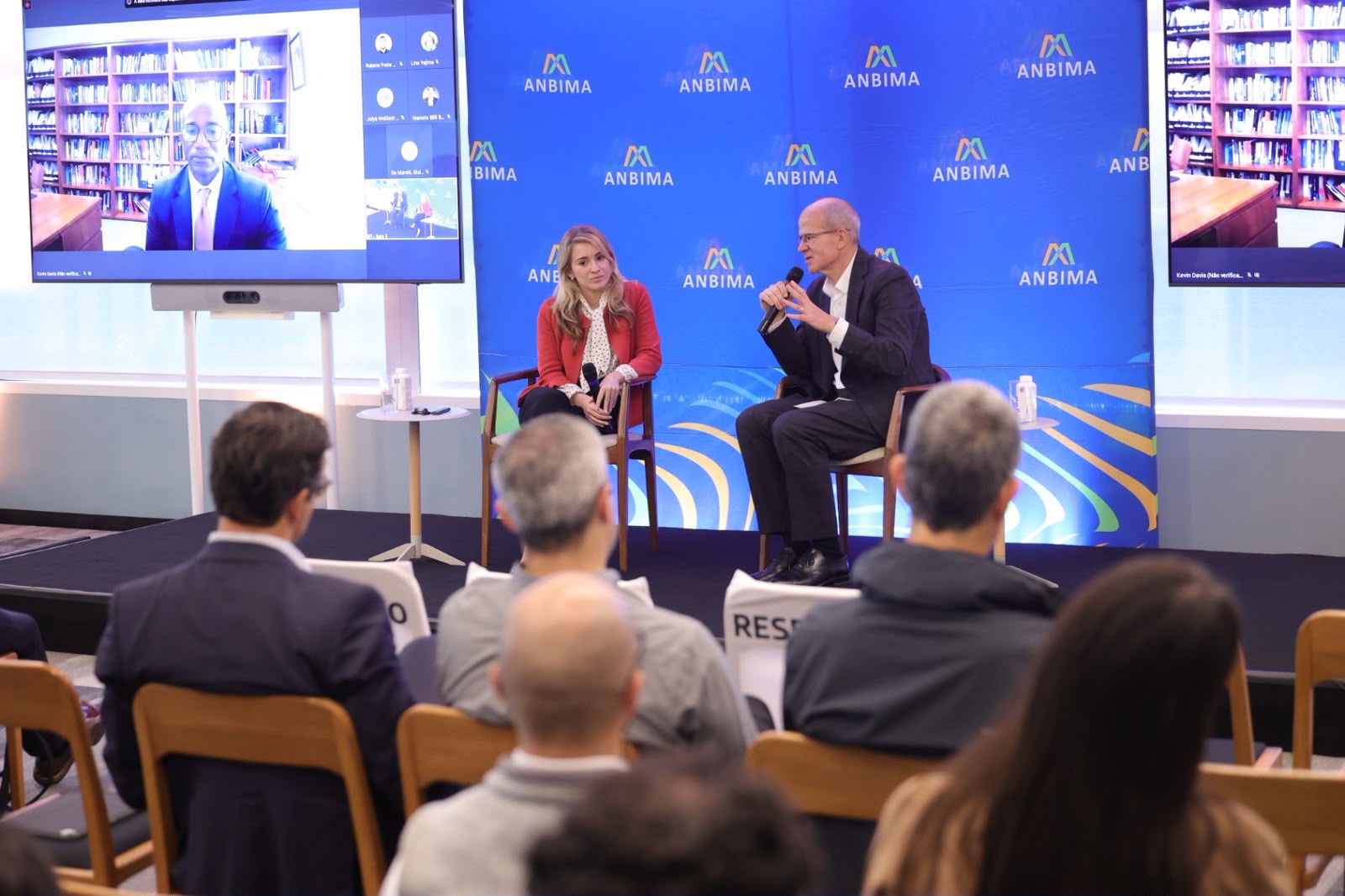
From left: Kevin Davis (on screen); Mariana Pargendler and José Carlos Doherty
Brazil’s financial and capital markets have a distinctive feature compared with the world's leading economies: a self-regulatory model that combines rulemaking, supervision and enforcement with technical cooperation with regulators, helping promote high standards of conduct and strengthen market confidence.
The conclusion comes from the study Anbima: Pillar of Brazil's Financial Markets, authored by Mariana Pargendler, a professor at Harvard Law School, and Kevin Davis, a professor at New York University School of Law (NYU). The report examines how different coordination mechanisms among market participants have contributed to the development of Brazil's financial and capital markets.
The authors argue that Brazil's experience shows how private coordination mechanisms can complement government oversight and support the development of sophisticated markets, offering lessons that could inspire other jurisdictions.
Institutional coordination
“In this environment, Anbima [Brazilian Financial and Capital Markets Association] plays an institutional coordination role in a market characterized by a diversity of participants, interests and business models. As a coordinating body, its work helps reduce information asymmetries, disseminate best practices and build consensus around standards that promote the integrity and efficiency of financial and capital markets,” Pargendler said. She presented the study for the first time to an audience of Anbima members on Thursday (13).
The assessment was conducted independently by the researchers based on interviews with regulators, academics and participants in the Brazilian market, as well as an analysis of publicly available information. Anbima's trajectory is used as a case study to illustrate the development of Brazilian capital markets.
“Anbima plays an institutional coordination role in a market characterized by a diversity of participants, interests and business models. The Brazilian experience shows how private coordination mechanisms can complement government oversight and contribute to the development of sophisticated markets, offering lessons that could inspire other jurisdictions,” Pargendler said.
“The findings are an important recognition of the association's work. They give us a sense of Anbima’s relevance to the market while also raising valuable questions about the challenges ahead. The market is evolving rapidly, society’s expectations are changing, regulators are transforming and new demands are emerging. It is therefore essential that we look ahead to ensure we maintain the relevance we have today,” said José Carlos Doherty, CEO of Anbima.
About the study
Anbima: Pillar of Brazil's Financial Markets was independently authored by Mariana Pargendler, a professor at Harvard Law School, and Kevin Davis, a professor at New York University School of Law (NYU). The research examines Anbima’s trajectory and its role in the development of Brazil’s financial and capital markets.
The full study is available here.
Study examines Anbima’s role in Brazil’s self-regulatory model
Published August 14, 2026
To share
Research by Harvard Law School’s Mariana Pargendler and NYU’s Kevin Davis highlights private coordination and regulatory cooperation in Brazil’s capital markets development
From left: Kevin Davis (on screen); Mariana Pargendler and José Carlos Doherty
Brazil’s financial and capital markets have a distinctive feature compared with the world's leading economies: a self-regulatory model that combines rulemaking, supervision and enforcement with technical cooperation with regulators, helping promote high standards of conduct and strengthen market confidence.
The conclusion comes from the study Anbima: Pillar of Brazil's Financial Markets, authored by Mariana Pargendler, a professor at Harvard Law School, and Kevin Davis, a professor at New York University School of Law (NYU). The report examines how different coordination mechanisms among market participants have contributed to the development of Brazil's financial and capital markets.
The authors argue that Brazil's experience shows how private coordination mechanisms can complement government oversight and support the development of sophisticated markets, offering lessons that could inspire other jurisdictions.
Institutional coordination
“In this environment, Anbima [Brazilian Financial and Capital Markets Association] plays an institutional coordination role in a market characterized by a diversity of participants, interests and business models. As a coordinating body, its work helps reduce information asymmetries, disseminate best practices and build consensus around standards that promote the integrity and efficiency of financial and capital markets,” Pargendler said. She presented the study for the first time to an audience of Anbima members on Thursday (13).
The assessment was conducted independently by the researchers based on interviews with regulators, academics and participants in the Brazilian market, as well as an analysis of publicly available information. Anbima's trajectory is used as a case study to illustrate the development of Brazilian capital markets.
“Anbima plays an institutional coordination role in a market characterized by a diversity of participants, interests and business models. The Brazilian experience shows how private coordination mechanisms can complement government oversight and contribute to the development of sophisticated markets, offering lessons that could inspire other jurisdictions,” Pargendler said.
“The findings are an important recognition of the association's work. They give us a sense of Anbima’s relevance to the market while also raising valuable questions about the challenges ahead. The market is evolving rapidly, society’s expectations are changing, regulators are transforming and new demands are emerging. It is therefore essential that we look ahead to ensure we maintain the relevance we have today,” said José Carlos Doherty, CEO of Anbima.
About the study
Anbima: Pillar of Brazil's Financial Markets was independently authored by Mariana Pargendler, a professor at Harvard Law School, and Kevin Davis, a professor at New York University School of Law (NYU). The research examines Anbima’s trajectory and its role in the development of Brazil’s financial and capital markets.
The full study is available here.
Study examines Anbima’s role in Brazil’s self-regulatory model
Published August 14, 2026
To share
Research by Harvard Law School’s Mariana Pargendler and NYU’s Kevin Davis highlights private coordination and regulatory cooperation in Brazil’s capital markets development
From left: Kevin Davis (on screen); Mariana Pargendler and José Carlos Doherty
Brazil’s financial and capital markets have a distinctive feature compared with the world's leading economies: a self-regulatory model that combines rulemaking, supervision and enforcement with technical cooperation with regulators, helping promote high standards of conduct and strengthen market confidence.
The conclusion comes from the study Anbima: Pillar of Brazil's Financial Markets, authored by Mariana Pargendler, a professor at Harvard Law School, and Kevin Davis, a professor at New York University School of Law (NYU). The report examines how different coordination mechanisms among market participants have contributed to the development of Brazil's financial and capital markets.
The authors argue that Brazil's experience shows how private coordination mechanisms can complement government oversight and support the development of sophisticated markets, offering lessons that could inspire other jurisdictions.
Institutional coordination
“In this environment, Anbima [Brazilian Financial and Capital Markets Association] plays an institutional coordination role in a market characterized by a diversity of participants, interests and business models. As a coordinating body, its work helps reduce information asymmetries, disseminate best practices and build consensus around standards that promote the integrity and efficiency of financial and capital markets,” Pargendler said. She presented the study for the first time to an audience of Anbima members on Thursday (13).
The assessment was conducted independently by the researchers based on interviews with regulators, academics and participants in the Brazilian market, as well as an analysis of publicly available information. Anbima's trajectory is used as a case study to illustrate the development of Brazilian capital markets.
“Anbima plays an institutional coordination role in a market characterized by a diversity of participants, interests and business models. The Brazilian experience shows how private coordination mechanisms can complement government oversight and contribute to the development of sophisticated markets, offering lessons that could inspire other jurisdictions,” Pargendler said.
“The findings are an important recognition of the association's work. They give us a sense of Anbima’s relevance to the market while also raising valuable questions about the challenges ahead. The market is evolving rapidly, society’s expectations are changing, regulators are transforming and new demands are emerging. It is therefore essential that we look ahead to ensure we maintain the relevance we have today,” said José Carlos Doherty, CEO of Anbima.
About the study
Anbima: Pillar of Brazil's Financial Markets was independently authored by Mariana Pargendler, a professor at Harvard Law School, and Kevin Davis, a professor at New York University School of Law (NYU). The research examines Anbima’s trajectory and its role in the development of Brazil’s financial and capital markets.
The full study is available here.
Get exclusive updates by email
Receive news, tips, events, and much more directly to your inbox.
Get exclusive updates by email
Receive news, tips, events, and much more directly to your inbox.